AgentSpec: A Modular Specification Framework for Controlled Analysis of Embodied Agents
Jixuan Chen, Jianzhi Shen, Haoqiang Kang, Zhi Hong, Qingyi Jiang, Soham Bose, Yiming Zhang, Leon Leng, Amit Vyas, Lingjun Mao, Siru Ouyang, Kun Zhou, Lianhui Qin
2026 · AI agent systems design Agent Evaluation
TL;DR: AgentSpec makes embodied agents modular, allowing researchers to swap and combine reasoning, memory, reflection, and learning components through standardized interfaces. Controlled experiments across DeliveryBench, ALFRED, MiniGrid, and RoboTHOR test how these combinations affect task performance and computational cost. The results show that stronger components do not automatically produce better agents: memory must match the reasoning strategy, and useful combinations depend on the environment. Short tasks benefit from step-by-step reasoning, while longer tasks rely more on state tracking. Lightweight, compatible combinations can outperform heavier, poorly matched pipelines in performance–cost trade-offs.
HasciDB: A Database for Identifying Cryptocurrency Airdrop Sybil Hunters
Adeline Wen, Chunyang Li, Shutong Qu, Leon Leng, Wei Cai
2026 · Others Sybil DetectionCrypto
TLDR: Cryptocurrency projects give away free tokens to reward early users. These giveaways, called “airdrops,” can be worth thousands of dollars per person. However, one person can create many fake accounts and collect the reward many times over. This fraud is called a sybil attack. Yet researchers have no shared, public database to study this fraud across different projects. We present HasciDB, the largest open-source airdrop sybil detection database, covering 2.54 million accounts across 16 projects (2020–2024). For every account, HasciDB checks for telltale signs of cheating. Examples include many accounts sending identical transactions within minutes, or funneling rewards to the same collection address. Across the dataset, 964,034 accounts (38.0%) exhibit suspicious patterns. Cross-project analysis shows that a project’s giveaway rules determine how much fraud it attracts. The most vulnerable project lost 87.4% of its tokens to suspicious accounts. The most resistant lost only 8.5%.
Accepted at Nanyang Blockchain Conference 2026/Website/Paper
Working Papers
Optimal Capping Theory for Heavy-Tailed Metrics in Experimentation
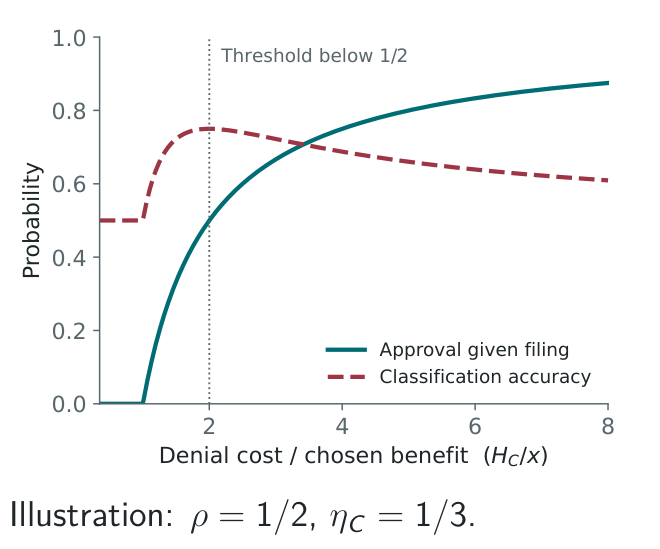
TL;DR: A few big spenders can make revenue experiments noisy. Capping their spending reduces noise, but may also remove real treatment gains. We use a prespecified belief about how treatment changes spending to choose the cap with the highest predicted signal-to-noise ratio, then estimate and test the capped effect using the same experiment’s observed data. Our first theorem bounds selection loss relative to the best score under that belief—not the true optimal cap. Our second shows that, under additional conditions including localization of near-optimal caps and a local capped-effect null, the test asymptotically controls false positives despite reusing the data. The belief need not be correct, but must be fixed independently of treatment assignment. Simulations show why this distinction matters: choosing the largest observed t-statistic inflates false positives, while a poorly matched belief can miss genuine revenue growth. Learning the belief from the same experiment remains work in progress.
Working paper · Draft available upon request
ExperimentWiki: From Experimental Evidence to Organizational Knowledge
Leon Leng, Shichao Han, Daimin Tang, Yong Wang, Shi Chen
2026 · Knowledge RSI Experiment DesignKnowledge Base ConstructionIndustry
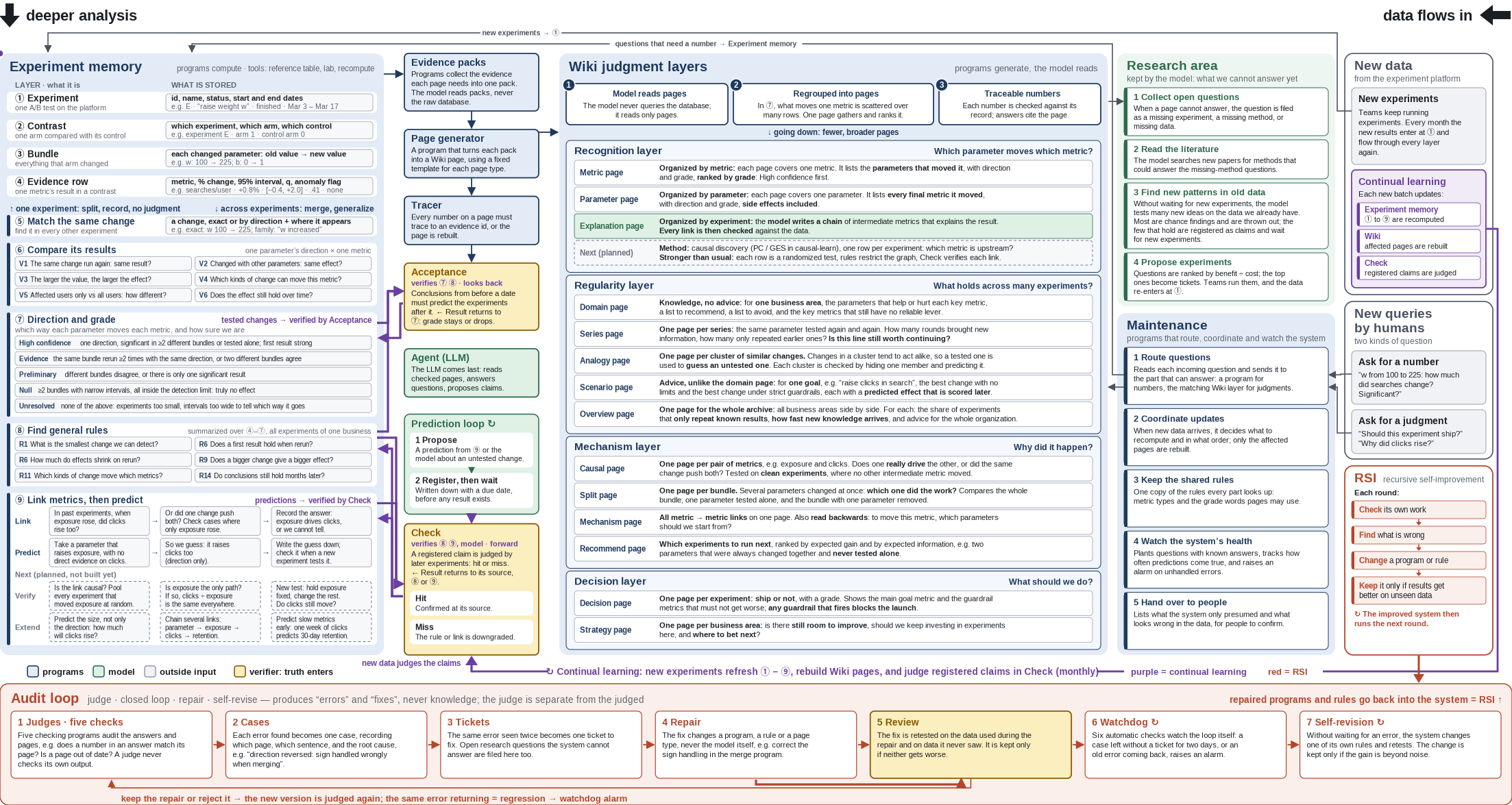
TL;DR: Experimentation platforms run thousands of A/B tests, but the knowledge they produce often remains scattered across reports and dashboards, making it difficult to accumulate, reuse, and test. ExperimentWiki explores how to turn historical experiments into institutional memory that AI agents can reliably use, while improving both the knowledge and the system that maintains it.
See moreSee less
The system first records which parameters each experiment changed, which metrics were affected, and the direction, magnitude, and statistical uncertainty of the effects. It then synthesizes evidence across experiments, examining consistency, applicability, and strength of evidence rather than simply pooling estimates from different populations and traffic volumes. Deterministic programs compute and store the statistics and generate structured Wiki pages from predefined templates. LLM agents build on this verifiable evidence to synthesize findings and advise business teams. Parameter pages summarize the metrics a change has historically affected; metric pages organize the parameter changes that have affected that outcome, allowing analysis to be reused across questions.
A researcher agent can identify gaps in the evidence and propose new experiments. If two parameters have always changed together, for example, it can suggest an experiment that separates their effects. The agent also registers predictions before new results arrive, allowing subsequent experiments to test whether the accumulated knowledge generalizes to unseen settings.
We distinguish two learning mechanisms. Continual learning keeps the system workflow fixed and uses new experiments or held-out historical experiments to test and revise existing conclusions. Self-improvement can keep the data fixed while using independent statistical recomputation, LLM review of execution traces, and human feedback to identify errors in tool selection, question routing, or analysis workflows. Proposed repairs are retested and retained only if they do not degrade existing performance. The first improves what the system knows; the second improves how it works.
The research focuses on continually accumulating, validating, and revising knowledge. Higher-level patterns and mechanism explanations remain hypotheses with varying evidential support, rather than established causal conclusions. Reliable self-improvement also depends on the reliability of the verifiers themselves.
Accepted at MIT CODE 2026 · Draft available upon request/Slides
Causal Benchmark and Post-training
Leon Leng, Shichao Han, Daimin Tang, Yong Wang, Shi Chen
2026 · AI for social science, economics and finance Causal InferenceBenchmarkingPost-trainingIndustry
TL;DR: Can language models reliably carry out causal analysis? Can post-training improve an open model’s capabilities in this domain while preserving its existing skills? We combine capability evaluation through Causal Bench with a study of open-model post-training to examine what models can currently do, what training changes, and why those changes occur.
See moreSee less
Causal Bench contains 328 questions across 16 topics, drawing on simulated data with known causal structure, real research datasets, and public benchmarks. Models receive a task description, variable definitions, and a small sample of the data, then generate analysis code and structured answers. The evaluation system executes the code on hidden data and programmatically checks results including method selection, effect estimates, and confidence intervals. On these well-specified tasks, the five strongest models achieve pass rates of approximately 93–95%, with no statistically distinguishable differences among them. However, translating conceptual knowledge into working analysis remains challenging: coding tasks widen the gap between models, and many failures among weaker models involve crashing scripts, truncated outputs, or formatting errors. Experiment design and diagnosis are also harder than basic causal concepts.
For post-training, we conduct two independent training runs on a 27B open model, examining continued pre-training, supervised fine-tuning, and reinforcement learning. Supervised fine-tuning raises performance on our in-domain test from approximately 59% to 87%, but also harms tool calling and performance on an external causal test. Further analysis reveals how the formats and behavioral patterns in training examples shape the model. For example, every tool-use training example contains exactly one tool call, leaving the model poorly prepared for tasks requiring no calls or multiple calls.
The second run introduces general-purpose replay data and targeted examples covering these missing behaviors. Targeted repairs recover much of the lost tool-use performance while largely preserving the in-domain gain, with some recovery on the external causal test as well. These results do not yet establish broad improvements in causal capabilities; reinforcement learning also produces no measurable additional in-domain gain in either run. The central lesson is to evaluate post-training by both what a model learns and what it loses, and to use concrete failure cases to identify causes that can be repaired.
Accepted at MIT CODE 2026 · Draft available upon request/Slides
Centralized Evaluation vs. Decentralized Evaluation
Leon Leng, Rowena Gan, Shi Chen
AI for social science, economics and finance
Working paper · Presented at INFORMS and POMS, 2025–2026
Work in Progress
Organizational Design and Compute Allocation for AI Agents
Microsoft Research Asia
2026 · AI agent systems design Multi-agent systemsOrganizational designCompute allocation
TL;DR: When should an AI team ask a manager for advice, and when should the manager have the final say? In the OfficeTown Playground, we give agents the same task and change who can share information or make a binding decision. Their messages and actions show where a team reaches agreement and whether it can still deliver on time.
See moreSee less
A scheduling pilot. Two sites needed the same engineering shift. Only the manager knew which contract had priority. In four model-driven runs, the manager awarded the shift to the higher-priority site every time. With standing authority, both sites filed on time in both runs. When employees first had to request arbitration, the other site filed its corrected plan one round late in both runs. The action logs show where the two rounds went. This small pilot leaves open how often the same pattern occurs on other tasks.
Choosing with distributed evidence. In a second case, product, sales and compliance agents propose ways to test a customer need. Each holds one fact about the cost of a demo. Each alone would choose an interview, yet pooling all three facts can make the demo the better choice. Scripted checks cover independent choice, nonbinding advice and a binding managerial decision. Model-driven trials of this case are pending.
Allocating compute. A companion simulation distributes a fixed token budget across tasks. It tests when estimates of task value are accurate enough for targeted spending to improve on an equal split. With sufficiently noisy estimates, targeting can perform worse. These estimates come from synthetic tasks.
Ongoing research
Applied Work
Auto Research: A Personal Research Library
Leon Leng
2026 · Knowledge RSI Research ToolsKnowledge Base ConstructionAI Agents
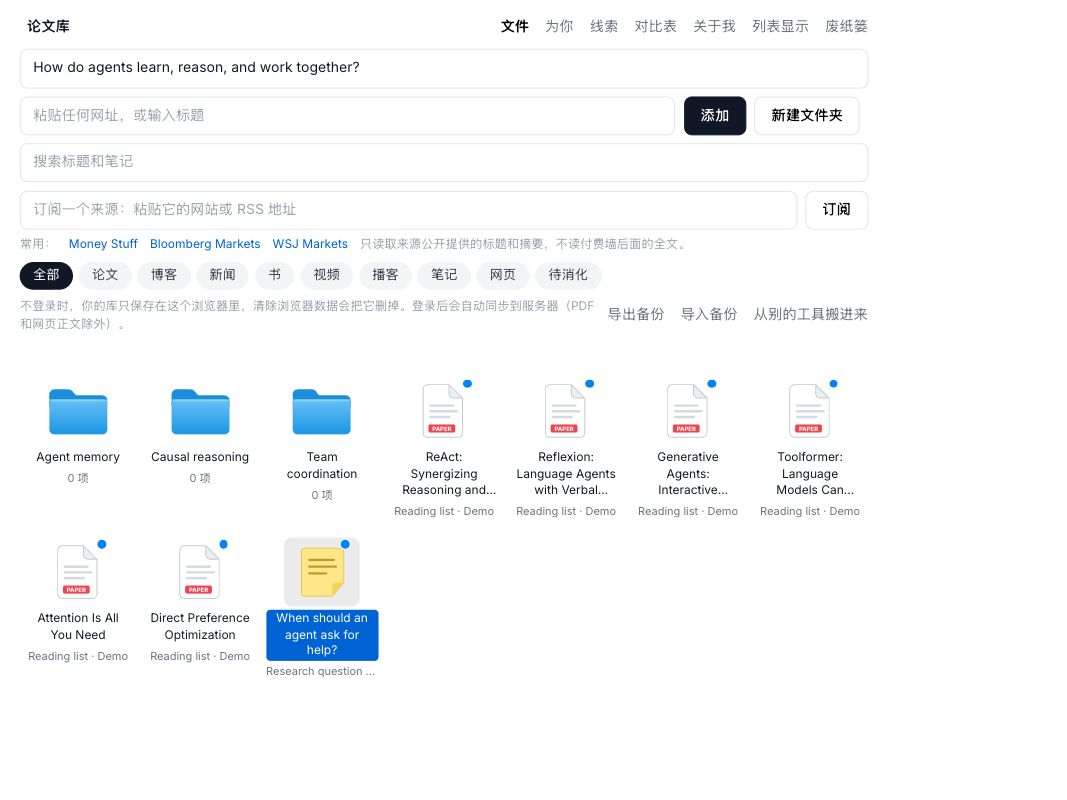
TL;DR: Saving a paper is easy; remembering how it changes your thinking is harder. Auto Research is a personal research library that organizes papers, webpages, and notes around questions you are following. It is designed to connect new material to those questions, distinguish supporting and conflicting evidence, and keep a record of how your conclusions change.
See moreSee less
A browser extension captures reading material, while imports and RSS subscriptions bring existing collections and new sources into the same library. AI-generated cards summarize each source; personal notes record what is useful for your own work. Research threads bring related claims together with source quotations, track open questions, and help draft cited summaries and research memos. Uncertain connections can be held for review. Markdown exports and an MCP interface make the library available to other research tools and agents.
Local prototype · In development
Worldlet
Digital twins and simulation
TL;DR: Worldlet is a platform for building and simulating worlds. A world can include a city like Shenzhen, from its buildings and streets to the activities that take place in them. Within that city, you can model how people and agents divide work in an office or set up a delivery scenario with orders, riders, and routes.
2026 · Applied Work AI Supply ChainKnowledge Base Construction
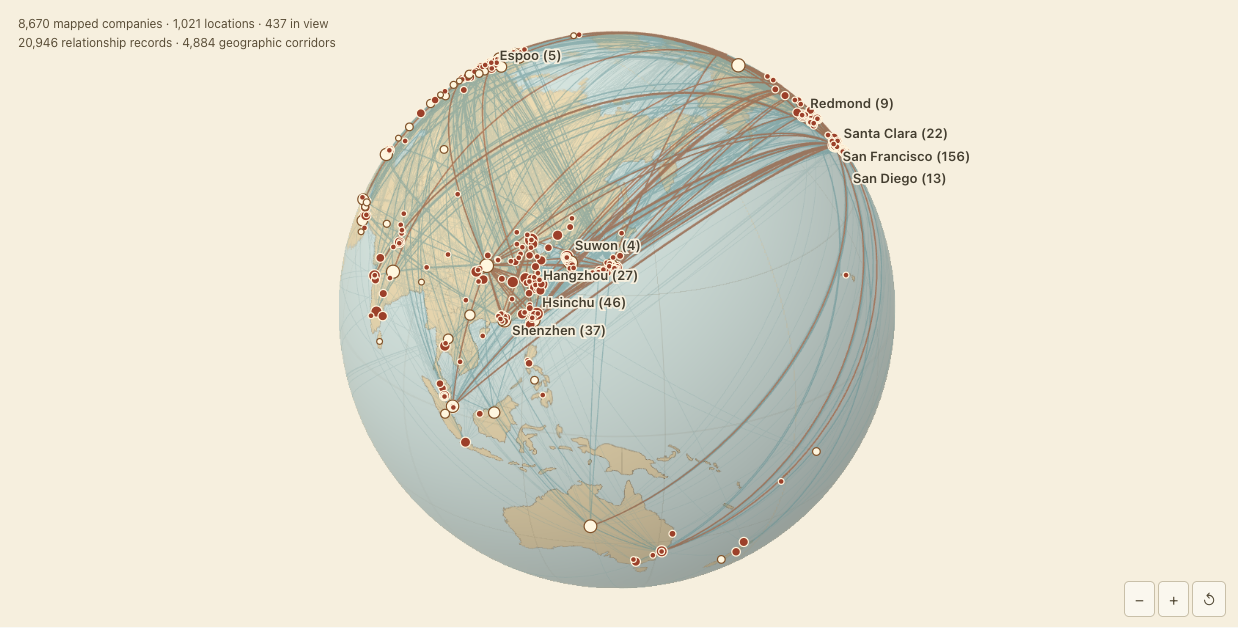
TL;DR: Sand to Model maps how chipmakers, cloud providers, and AI developers depend on one another. The AISight database connects supply agreements, investments, and partnerships to the public records that document them.
See moreSee less
Select a company on the globe to explore its connections. The project also tracks talent flows and data center locations, and publishes research on questions such as how much computing capacity companies reserve before delivery.